
Topic Tags:
Navigating the complexities of waste disposal in a healthcare setting is a high-risk operational challenge. Improper waste management in aged care not only poses severe health risks to residents and staff but also exposes facilities to significant compliance failures and financial penalties. Facility Managers and Infection Control Leads must maintain strict oversight of waste segregation, storage, and disposal to ensure their site consistently meets regulatory expectations. This guide details the essential components of a compliant waste management strategy aligned with the Aged Care Quality Standards.
Meeting Aged Care Quality Standards Standard 4
Aged care facilities are heavily regulated environments, and Standard 4 (The Environment) of the Aged Care Quality Standards explicitly requires providers to offer a safe and comfortable clinical environment. A critical element of this standard is the safe and effective management of waste. Compliance audits frequently scrutinise waste handling procedures, looking for evidence of proper segregation and secure disposal. Misunderstandings often occur regarding the classification of waste types; many staff mistakenly dispose of general waste in clinical bins, which dramatically inflates disposal costs and complicates processing. Accurate categorisation is the foundation of aged care waste compliance.
Segregation and Handling of Clinical Waste
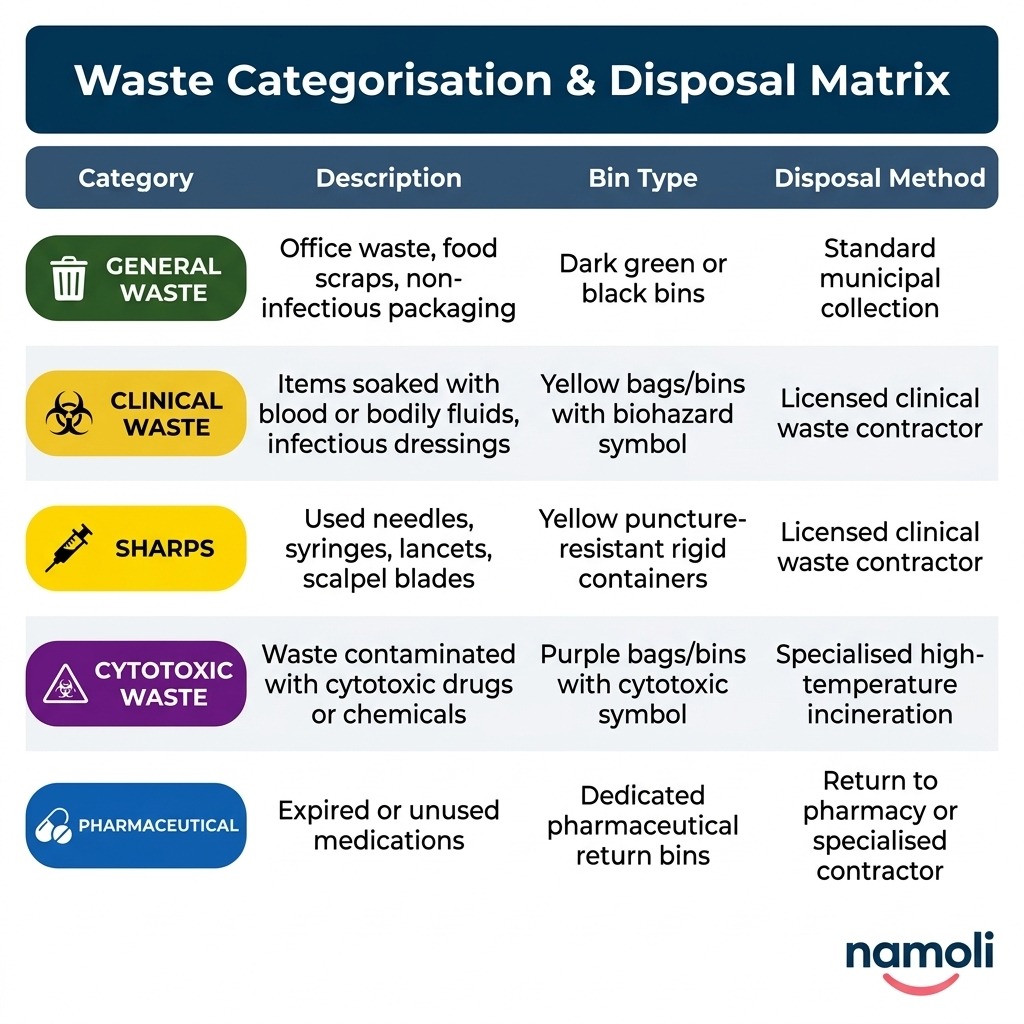
Clinical waste poses a potential infection risk and must be handled with precise care, consistent with broader infection control procedures in aged care. Clinical waste disposal in aged care typically includes items heavily soiled with blood or bodily fluids, as well as specific medical dressings.
Staff must be trained to identify and isolate clinical waste immediately at the point of generation. This waste must be placed in designated yellow bags or bins, which are clearly marked with the biohazard symbol. In most cases, these bins should be foot-operated to minimise hand contact and reduce cross-contamination. Secure storage areas, inaccessible to residents and the general public, are required for holding clinical waste prior to collection by a licensed contractor. These storage zones should align with your facility’s clean zone protocols to prevent cross-contamination.
Sharps Disposal in Aged Care Facilities
The management of sharps represents one of the most critical safety protocols within any care environment. Sharps disposal in aged care across Australia is governed by strict occupational health and safety regulations. Used needles, syringes, and lancets must be disposed of immediately into approved, puncture-resistant yellow sharps containers.
Managing Other Specialised Waste Streams
Beyond general, clinical, and sharps waste, aged care facilities must also safely manage other specialised waste streams, most notably cytotoxic and pharmaceutical waste. Cytotoxic waste, which includes materials contaminated by chemotherapy drugs or related treatments, must be segregated into purple-coded containers to signify the need for incineration.
Pharmaceutical waste, encompassing expired or discarded medications, requires disposal in dedicated bins to prevent environmental contamination or unauthorised access. Proper management of these distinct categories is essential to prevent severe environmental and occupational health hazards.
Waste Categorisation and Disposal Matrix
Implementing a clear, visual system helps staff make quick, accurate decisions regarding waste disposal. The following infographic provides a standard framework for waste segregation in an aged care setting.
Real-World Application: Optimising Waste Streams
Consider a mid-sized aged care facility that recently failed an internal audit due to overflowing clinical waste bins in resident bathrooms. Upon investigation, the Facility Manager discovered that care staff were throwing used, non-infectious incontinence aids into the clinical waste stream instead of the general or offensive waste streams. By implementing a targeted staff education program on correct waste segregation and introducing clearly colour-coded bins in all bathrooms, the facility not only resolved the compliance issue but also reduced their monthly clinical waste disposal costs by thirty per cent.

Sustaining Compliance Through Education
Maintaining a compliant waste management system requires ongoing vigilance. Staff turnover in the aged care sector means that training cannot be a one-off event. Regular refresher courses on waste segregation, hand hygiene, and the use of personal protective equipment (PPE) are essential to maintain standards and protect the facility during unannounced audits. For a comprehensive overview of the cleaning benchmarks your facility should be meeting, see our guide to aged care cleaning standards in Australia.
A robust approach to waste management protects your residents, your staff, and your organisation’s reputation. Review your facility’s current waste segregation practices and update your protocols to ensure total alignment with the 2026 standards.



Related Posts